

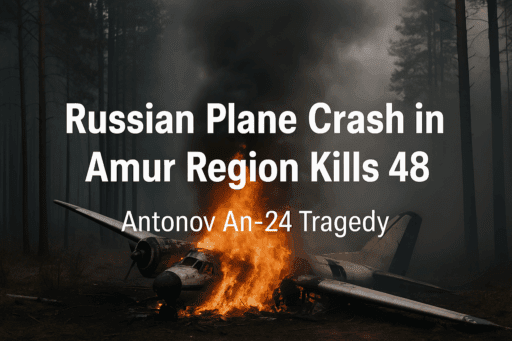
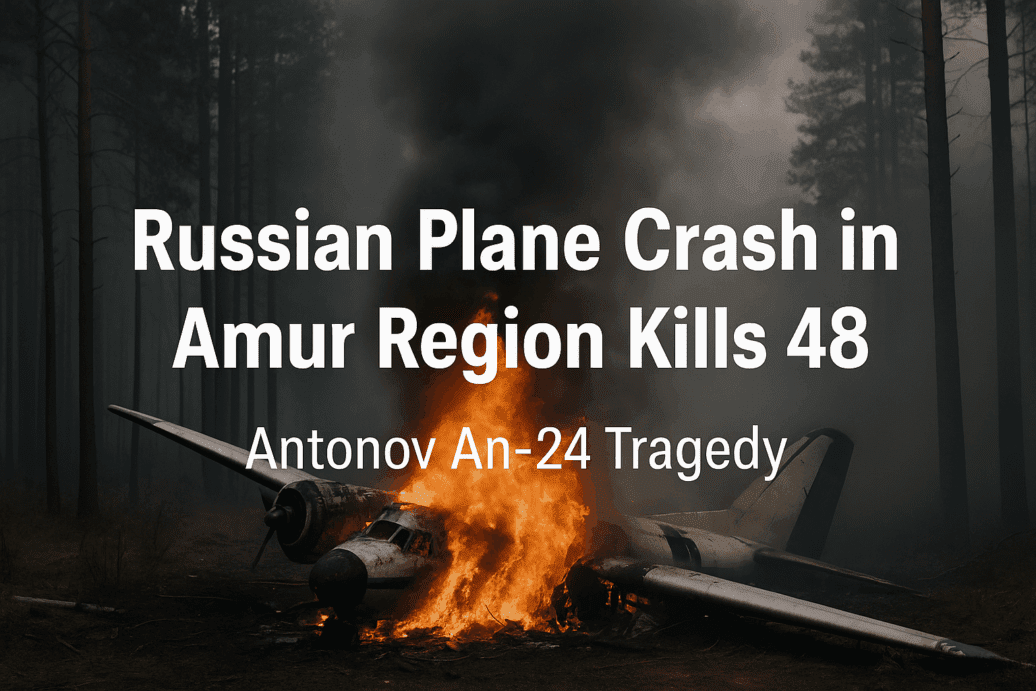

A devastating air disaster has shaken Russia’s aviation sector and drawn global attention to the aging infrastructure of regional carriers. On July 24, 2025, a Soviet-era Antonov An-24 aircraft operated by Angara Airlines crashed near the remote town of Tynda in the Amur region of eastern Russia, killing all 48 people on board, including crew and children.
This tragedy marks one of the deadliest aviation incidents in recent years and has prompted questions about safety standards, fleet maintenance, and operational readiness in one of the harshest flying environments in the world.
The Flight That Never Made It
The ill-fated flight departed from Blagoveshchensk, a city on the Russia-China border, and was en route to Tynda, approximately 570 kilometers away. The Antonov An-24 was nearing its destination when it disappeared from radar. Notably, there was no distress signal, adding to the mystery and urgency of the situation.
Authorities later confirmed that the plane was attempting its second landing approach when it veered off course and crashed into a dense forest roughly 16 kilometers south of Tynda Airport.
Wreckage in the Wilderness
Rescue teams faced an uphill battle. The crash site was located in rugged, mountainous terrain surrounded by thick forest. The aircraft was discovered engulfed in flames, and initial reports suggest the fire spread rapidly, making recovery efforts extremely difficult.
Despite prompt deployment of emergency services, there were no survivors. The local government declared three days of mourning, and grief-stricken families gathered to identify their loved ones and seek answers.
The Aircraft: Aged but Still in Service
One of the most striking aspects of this tragedy is the age of the aircraft involved. The Antonov An-24, built in 1976, was nearly 50 years old. While many nations have phased out older models in favor of modern jets, some Russian regional carriers continue to operate these planes, particularly in remote or underserved areas where newer models are less feasible due to infrastructure limitations.
Angara Airlines had reportedly extended the aircraft’s airworthiness certificate through 2036 a decision that now faces scrutiny from aviation experts and the public alike.
Investigators Eyeing Human Error
Preliminary investigations suggest that crew error in poor weather conditions may have played a significant role in the crash. Visibility in the area was low, and the pilots were making a second attempt at landing. While mechanical failure has not been ruled out, the current working theory centers on pilot misjudgment or disorientation.
Russian authorities have launched a criminal investigation, and flight recorders (black boxes) have been recovered for analysis. The full report could take weeks or months, but early indications already hint at the systemic issues facing Russia’s domestic aviation sector.
Aviation Under Pressure in Sanctioned Russia
Beyond this specific crash, the disaster underscores a much larger issue. Since 2022, international sanctions have cut off Russian airlines from Western aircraft parts, simulators, and maintenance software. This has forced airlines to extend the life of outdated planes, often improvising repairs with limited resources.
In regions like the Russian Far East and Siberia, where harsh weather and limited infrastructure complicate operations, such challenges become even more dangerous.
Community Reactions and Mourning
The Amur region has been deeply impacted. Schools, businesses, and government offices flew flags at half-mast as residents paid tribute to the victims. Local leaders called the incident a “national tragedy,” and calls for stricter oversight and modernization of regional aviation grew louder.
Social media platforms in Russia were flooded with tributes, criticism, and questions. Many users demanded to know why such old planes were still in use and how future disasters could be prevented.
What’s Next for Russian Aviation?
This crash is likely to become a turning point for discussions around air safety in post-sanctions Russia. The government is under pressure to:
- Accelerate the modernization of domestic fleets
- Improve pilot training and weather response protocols
- Increase investment in infrastructure for smaller airports
- Rebuild global partnerships for aviation safety and maintenance
Whether or not these reforms materialize remains to be seen. But for now, the crash of Angara Airlines’ An-24 serves as a somber reminder of the human cost of neglecting safety in the face of operational challenges.
As investigations continue, one thing is clear: this tragic crash is not just an isolated incident, it’s a wake-up call. The loss of 48 lives could have been prevented with better systems, newer equipment, and safer procedures.
The aviation world will be watching closely as the Russian authorities respond, investigate, and hopefully act to prevent such disasters from happening again.